Wednesday, July 28, 2010

You Can’t Go Wrong with Avi

Midnight Magic by Avi (Scholastic, 1999, 249pp.)

It’s 1491, Renaissance Italy. When Mangus the Magician and his loyal servant, Fabrizio, are enlisted to banish a ghost haunting the royal family, they soon learn that there’s more at stake than just their lives—the entire fate of the kingdom rests in their hands as well! As usual, you can’t go wrong with Avi. Vividly drawn characters and a labyrinthine plot with more than a few twists and turns prove this to be a light, fun thriller from one of the masters of young adult and children’s literature. Recommended for Ages 9-12.

Click on the cover for image source.

Tuesday, February 23, 2010

A Truly Magical Film


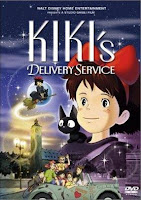
Kiki’s Delivery Service. Dir. Hayao Miyazaki. 1989. 103 min. Rated G.


The film starts at the beginning of a journey. As dictated by traditional custom, young Kiki is granted independence at the age of thirteen so she may begin the year-long training away from home to cement her status as a bona fide witch. She leaves behind her loving parents and small town and relocates herself to a large city, which (though nonexistent) has distinctly European features. However, she soon learns that the rules of the city (and life) are not quite as she imagined.

Eiko Kadono, author of the book on which the film is based, and Hayao Miyazaki, the screenwriter and director, are both Japanese. Although the film takes place in a made-up world, it can be said that those who craft the film leave their own mark on the story, demonstrating the proper values thought important. Kiki demonstrates the archetypal Japanese trait of showing respect for her elders.

Since she has no special talents (except for flying on a broom, which she does haphazardly at best), her training consists of learning how to support herself, which she accomplishes by establishing an air delivery service (via broomstick). Kiki’s growth as a character evolves through her interaction with her customers. At least three of her female customers act as second mothers, aiding her in the gradual transition from the sheltered childhood she knows into the reality of young adulthood. This supportive network of parental-substitutes allows Kiki, and young viewers, as well, to explore her new environment safely. Kiki’s work ethic is impressive in a child so young. She earns the respect of adults through her earnest and diligent behavior. She also learns that items she took for granted before (food, cooking implements) cost money and can be somewhat expensive. She cooks and cleans for herself, and finds herself scrimping when money is low. Although she longs to own nice clothes, she notices that even the price on a pair of shoes she admires in a store window is equal to, or more than, the amount she spends on groceries alone.

Even though Kiki serves as a role model towards young children, she also stands as a figure they can empathize with. She has the same doubts and disappointments as everyone else. Her stay in the city, for example, doesn’t begin as well as she had hoped. The city is not warm and inviting like her hometown. Her attempts to introduce herself to strangers are at first met with indifference. She is insulted when an incredulous hotel desk clerk doesn’t believe her when she asks to rent a room without her parents present. “No one seems to like witches in this town,” she observes sadly. Her sense of alienation is present whenever she is around children her age. When her new friend (and love interest) Tombo introduces her to his usual gang of friends, she finds herself unable to relate to them. She feels herself to be “an outsider.” Her insecurities and failed self-confidence affects her ability to do magic: she can no longer fly a broomstick, and she can no longer communicate with her black cat, Jiji. She feels lost without the very thing that makes her feel special. Her host family and friends give her the emotional support she needs to regain her self-confidence. It is put to the ultimate test when she is the only one who can save Tombo, who is dangling from a rope attached to a runaway dirigible and faces certain death if he falls.

Kiki’s Delivery Service is a sweet, lovely film about what happens when life disrupts our preconceived notions, and the sense of loss and insecurity which takes place after. The pacing is sometimes slow and methodical that might not work with younger elementary students. With its discussion of teenage independence, it will probably have the most developmental impact for children in their preteens. Recommended for Ages 9-12, this is also a film that parents, too, can appreciate.

Click on cover for image source.

As Annoying As It Is Sparkly


Little Sister is NOT My Name! (Sassy #1) by Sharon M. Draper (Scholastic Press, 2009, 102pp.)

Nine-year-old, pint-sized Sassy has big problems. As the youngest (and smallest) of three children, she is so short that she can’t reach things on high shelves without difficulty. Not only that, but her well-meaning family can’t seem to remember how much she hates the nickname “Little Sister.” It is only after her family is stuck in an elevator between floors, and she is the only one small enough to slip through the doors to go for help, that she feels that she has proved her worth. Yet Draper’s otherwise admirable attempt to buoy the self-image of vertically challenged children is sadly undermined by the glittery, brand-naming gusto of its own protagonist. Armed with her fashionably decorated “Sassy Sack,” a combination backpack/emergency kit that seems to contain everything but a cardiac defibrillator, the self-assured Sassy wins the respect of both teachers and classmates for always having the right supplies at the right time. With more fashion-sense and admirers than the average third-grader, Sassy has little else to recommend her to the position of underdog. Nevertheless, the “wish-fulfillment” quality of the story, bound in a sparkly cover that features its protagonist flanked by her culturally diverse array of friends, should appeal to most nine-year-old girls. Recommended for Ages 9-12.

Click on cover for image source.

A Story As Sweet As Its Title


Strawberry Hill by Mary Ann Hoberman (Little, Brown and Company, 2009, 230pp.)

Miserable that she must leave her best friend behind when her family moves to another city, fourth-grader Allie finds herself in the uncomfortable situation of having to make new friends. The contrasting development of the two prospective new friends, the unpopular school “crybaby” Mimi, and the more appealing but ultimately fickle Martha, exposes Allie to the sometimes troubling complications that often accompany friendships. Set during the Depression Era, Strawberry Hill sends an important message to young female readers about unconditional loyalty and the importance of staying true to yourself in the face of peer pressure. Recommended for Ages 9-12.

Click on cover for image source.

Origin-Story of Literal-Minded Ninny Fails to Impress


Amelia Bedelia’s First Day of School by Herman Parish, Illus. Lynne Avril (Greenwillow Books, 2009, 32pp.)

This book chronicles the literal-minded Amelia Bedelia’s first day at school. Her humorous misadventures are sure to be somewhat entertaining: her teacher tells her to glue herself to her seat, the bus driver tells her to jump off the bus, the librarian encourages her to bury her nose in a book, all of which she interprets literally. While it is an admirable effort, and not a bad picture book by any means, it certainly isn’t a dazzling one either. The situations that the author chose for Amelia Bedelia to misinterpret are predictable and not really that interesting. Compared to the original series, Amelia Bedelia the child is not nearly as compelling as Amelia Belia the adult. Recommended for Ages 4-8.

Click on cover for image source.

Look Out, Beatles Fans: Lucy's No Longer in the Sky with Diamonds...


Lucy Long Ago: Uncovering the Mystery of Where We Came From by Catherine Thimmesh (Houghton Mifflin Books for Children, 2009, 63pp.)

An earth-shattering discovery in Ethiopia rocked the anthropological world when scientists unearthed the skeleton of a little creature whose like had never been seen before. A mere 3.2 million years ago, the skeleton dubbed “Lucy” had walked on two legs, and defied all categorization scientists had made thus far—was she an early ancestor of man or ape? How did she live? What did she look like? This beautifully designed and informative picture book is eloquent in its treatment of the subject. The author lays out, step by step, the process that takes place when handling field work. The only complaint one can make is the lagging pace of the material towards the end: it provides a satisfying conclusion, but younger readers or those with short attention spans might lose interest. Recommended for Ages 9-12.

Click on cover for image source.

Ghastly Murder Provides For Rich Listening Experience


The Composer is Dead by Lemony Snicket, Illus. Carson Ellis, Music by Nathaniel Stookey (HarperCollins Publishers, 2009, 40pp.)

The Composer is dead, and someone, according to the Inspector, must be held accountable. From the creator of A Series of Unfortunate Events comes this unique and fresh examination of musical performance. While the book can be read on its own, it is accompanied by a recorded narration performed by none other than Lemony Snicket himself. As the Inspector accuses each section of murder, the Instruments (played beautifully by the San Francisco Symphony) defend themselves using an eloquent combination of speech and classical music. However, as daring as this work is, the musical breaks between narration sometimes border on excessive length, and younger readers may lose interest. For the older child who has an appreciation for classical music, this is a rare treat indeed. Recommended for Ages 9-12.

Click on cover for image source.